Pulse-80 specifications have been defined, validated and qualified over -40°C to +71°C and in all conditions (thermal, vibrations, shocks and lifetime). The performance parameters presented in this document express typical (1 σ), and 3 sigmas specifications.

Each Pulse-80 Inertial Measurement Unit is carefully calibrated over the whole temperature range using a high precision two axis motion simulator (see knowledge center). The IMU performance is then validated after a resting period after the calibration, using several temperature points with a two axis rate table to ensure that no performance deviation is observed.

This rigorous manufacturing process guarantees consistent results over lifetime and in all environmental conditions. Advanced filtering techniques are also used to allow PULSE-80 sustains difficult vibrating environments.

The following specifications are applicable over the full temperature range -40 to 71°C and RH < 80% unless stated otherwise.
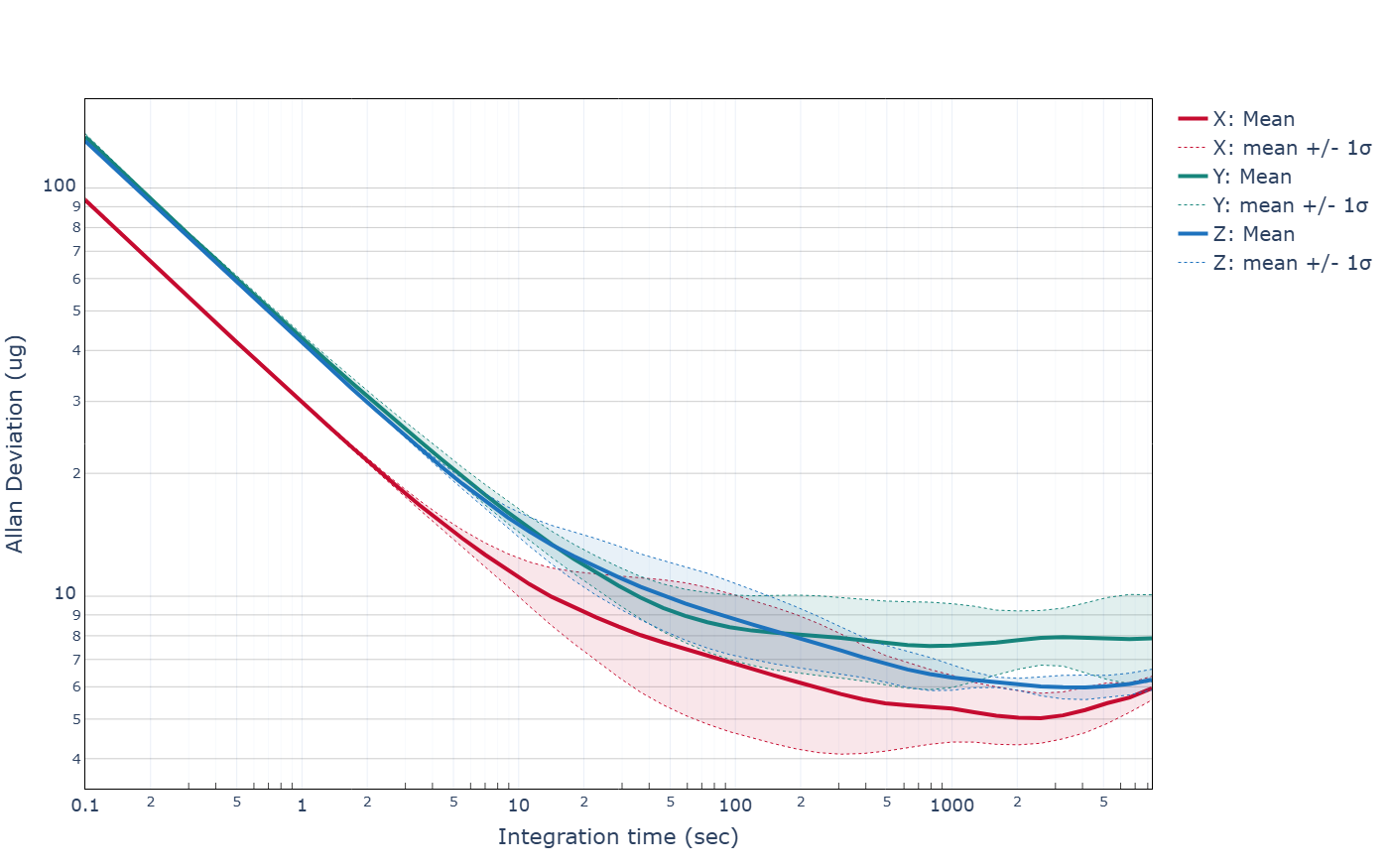
Accelerometers specifications


TypicalUnitsNotes
Measurement range

±40

g


Scale Factor error40ppmOver ±1g, one year accelerated aging
Non-linearity (ppm of FS)0.5ppmOver ±1g, one year accelerated aging
Long-term bias repeatability

1250

µgOne year accelerated aging
In-run bias instability6µgAllan Variance method, constant temperature
Velocity Random Walk0.02m/s/√hAllan Variance method, constant temperature
Noise spectral density45µg/√HzWide-band noise ]0 to 100] Hz
Misalignment 0.3mradOver operating temperature range
Orthogonality0.1mradOver operating temperature range
Vibration Rectification Coefficient (VRC)0.1mg/g²10g RMS - random vibrations 20Hz to 2kHz
Bandwidth100Hz-3dB point
Allan Variance

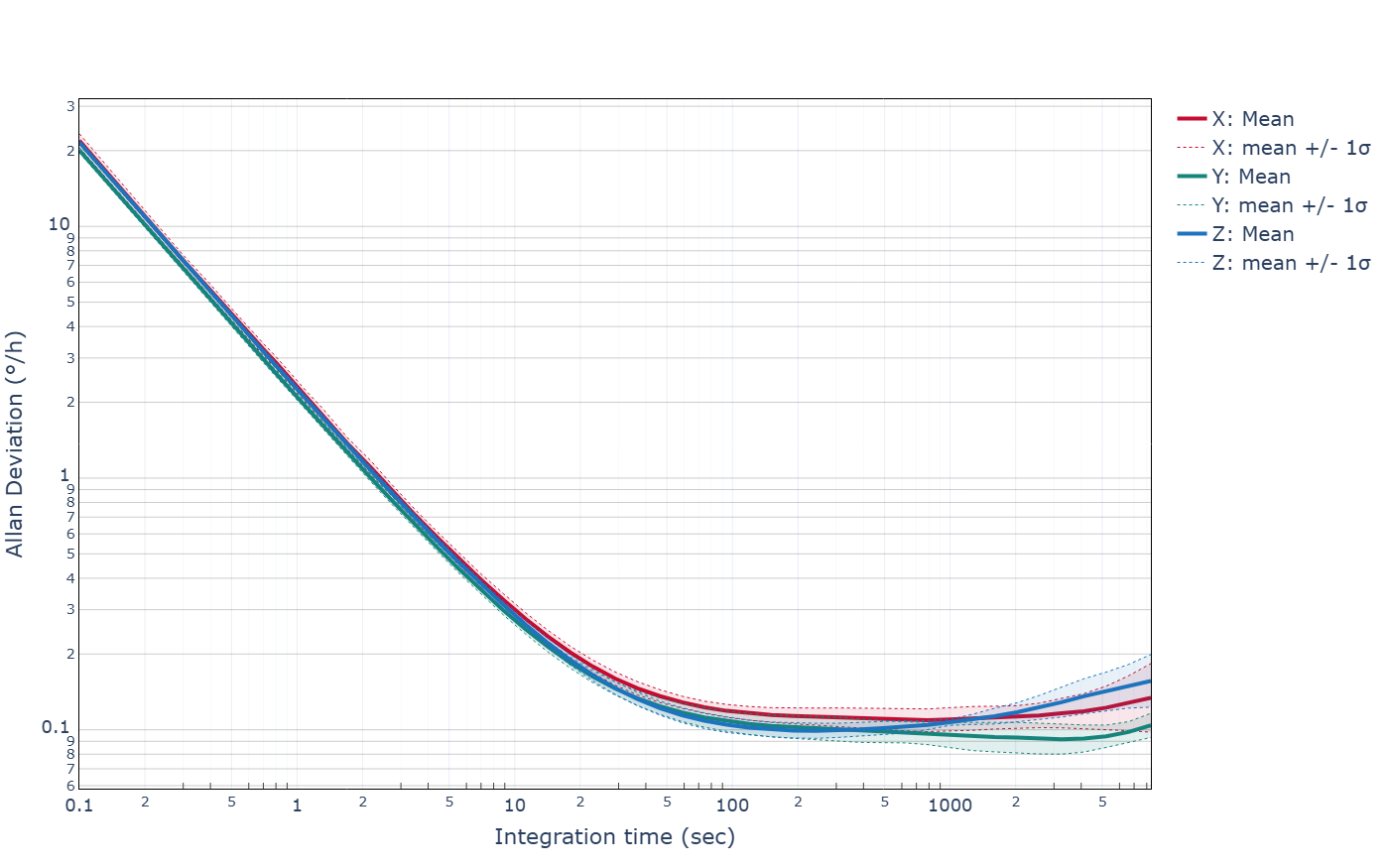
Gyroscopes specifications


TypicalUnitsNotes
Measurement range

±400

°/s


Scale Factor error150ppmOne year accelerated aging
Non-linearity (ppm of FS)40ppmOne year accelerated aging
Long-term bias repeatability20°/hOne year accelerated aging
In-run bias instability0.1°/hAllan Variance method, constant temperature
Angular Random Walk0.01°/√hAllan Variance method, constant temperature

Noise Spectral density 

0.7(°/h/√Hz)Allan Variance method, constant temperature
Wide band noise ]0 - 100 ] Hz0.1(°/s RMS)PSD method, constant temperature
Misalignment 0.3(mrad)Over operating temperature range
Orthogonality0.1(mrad)Over operating temperature range

VRC

0.03(°/h/g² rms)10g RMS - random vibrations 20Hz to 2kHz
Acceleration sensitivity 0.22(°/h/g)Tested over ±1g
Bandwidth100Hz-3dB point
Allan Variance